Overview
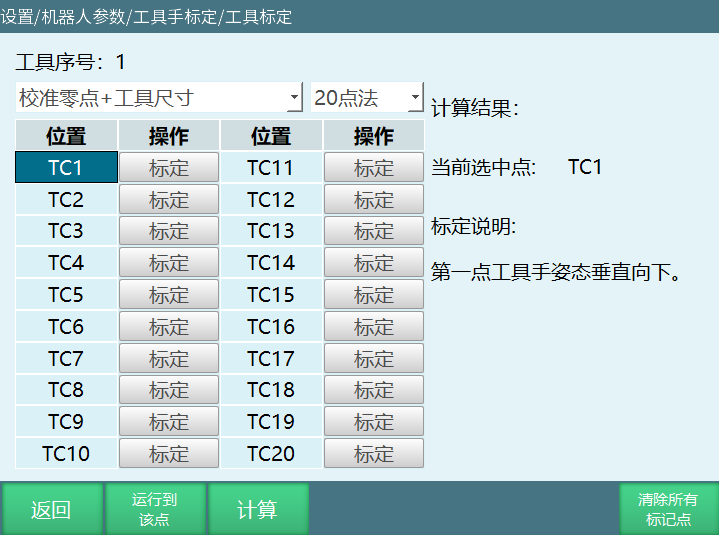
How accurately a robot works starts with how accurately the TCP (Tool Center Point) is calibrated. Building on the previous 12-point and 15-point methods, this is another upgrade in accuracy. Our 20-point method uses 20 sets of pose data for the calculation, so small deviations in individual points are diluted — the calibrated TCP is more stable and more accurate.
Key Advantages
1. 20 Poses Computed Together — Robust Against Individual Bad Points
4-point or 6-point methods use too few points: one shaky point skews the result. With 20 points fitted together, even if one point is slightly off, the impact is negligible — strong anti-interference capability.
2. Full Angular Coverage — Orientation Changes Don't Cause Drift
Sampling covers large positive and negative rotations around the A/B/C axes, unlike traditional methods that only check a few poses near the taught points. Once the TCP is calibrated this way, the robot stays accurate no matter how it reorients.
3. Stable Even with Long or Eccentric Tools
With too few points, long torches or eccentric fixtures can easily produce wildly wrong results. With 20 points, the sample size is large enough for the algorithm to handle them — welding torches, fastening mechanisms, polishing heads and custom tooling all work.
4. Repeatable Results Every Time
With ample redundancy in the points, calibrating the same tool three times yields nearly identical results. After product changeovers, reinstallation or collision-related recalibration, the TCP parameters stay stable — no repeated fine-tuning.
5. One Shot for Everything — No Separate Steps
One set of 20 points yields both the zero point and the tool dimensions in a single pass — no need to calibrate one first and then the other, saving effort and eliminating one source of error.
Applicable Scenarios
Anything with high TCP accuracy requirements: welding, fastening, polishing, assembly and vision-guided tracking — especially long tools, eccentric mounting and applications requiring wide orientation changes.
Value & Benefits
- Higher yield: with an accurate TCP, welds don't wander, screws don't strip and assemblies don't misalign
- Shorter commissioning time: stable calibration means no repeated fine-tuning and faster changeovers
- Lower operator skill demands: the multi-point algorithm is highly fault-tolerant, minimizing the impact of individual technique