Industry Landscape
As 3C products continue to evolve toward smaller, thinner and lighter designs, PCB screw points are densely packed with minimal spacing. The fastening process directly affects structural strength, water resistance and product reliability, making it a critical operation that must be strictly controlled and fully traceable. With monthly output of flagship products often reaching the million-unit level, the fastening station easily becomes a production-line bottleneck.
Customer Pain Points
- Micron-level screw holes rely on manual visual alignment; defects such as skewed fastening, stripped threads and screw float are difficult to identify in-process
- Manual fastening takes 1.5–3 seconds per point, keeping the fastening station a perennial bottleneck with high staff turnover
- Product iteration cycles are as short as 2–3 months, and line changes require stopping production for re-teaching, making it impossible to adapt to small-batch, multi-variety production
- Without structured fastening data, batch defects cannot be precisely traced and factory-audit compliance requirements cannot be met
The iNexBot Solution
Precise positioning — a single 2D industrial camera pass identifies the position and angular deviation of every screw hole, outputting pixel-level compensation with alignment accuracy of ±0.02 mm.
Reliable fastening — the servo screwdriver controls torque, speed and angle in real time with accuracy of ±0.5°, capturing the complete fastening curve and improving yield by 5%–15% over manual operation.
Rapid line changeover — each product has its own program template that can be invoked with one click, completing changeover in minutes.
Full traceability — the torque-angle-time curve of every screw is recorded in full, bound to the product SN and uploaded to MES, meeting the factory-audit requirements of mainstream brands.
Cost reduction & efficiency gains — each station replaces 1–2 workers and supports 24-hour continuous operation, with an investment payback period of approximately 6–12 months.
System Components
| Module | Description |
|---|---|
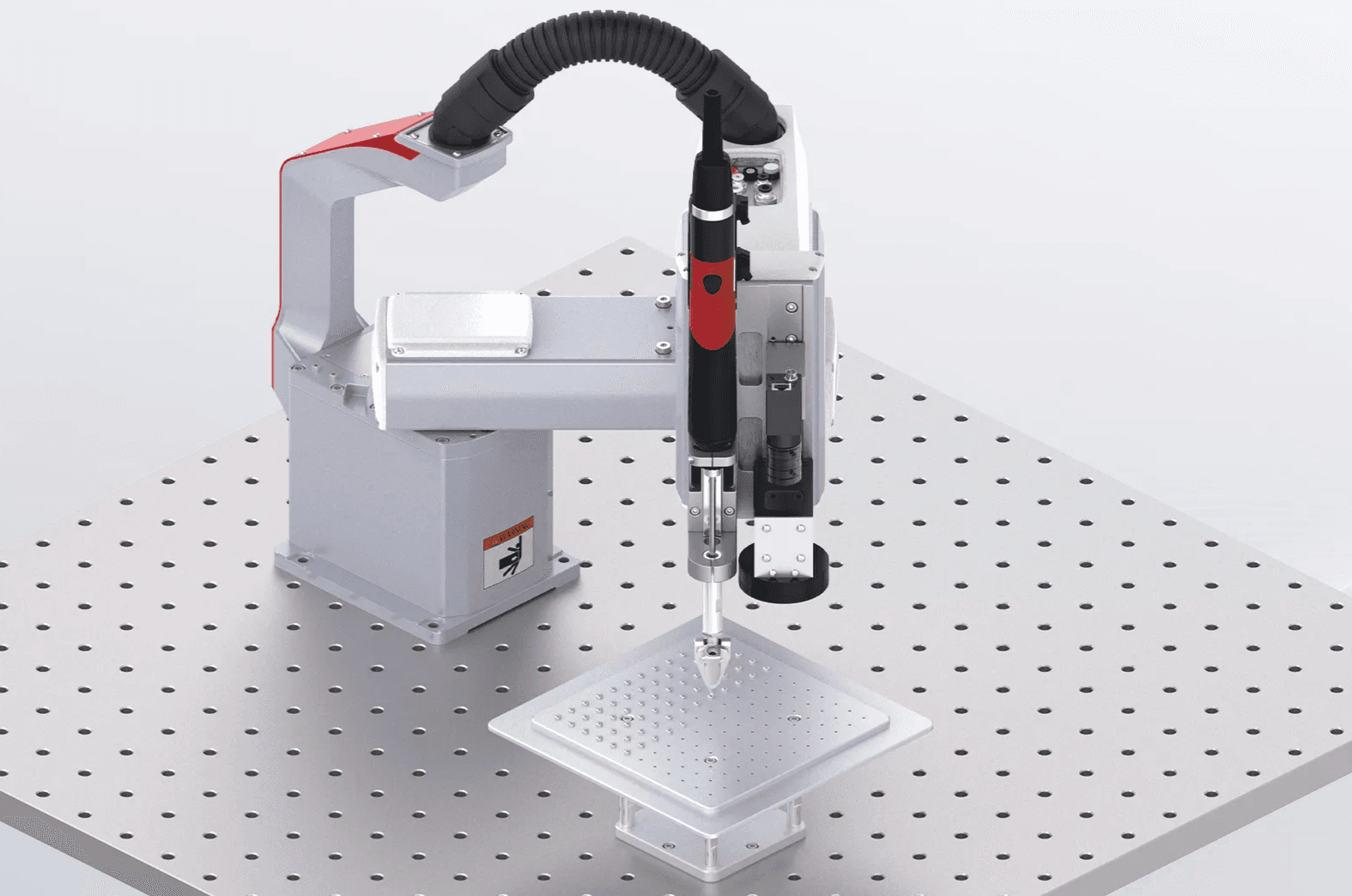
| Three-axis SCARA robot | High-speed X/Y motion + Z-axis press-down: high precision, fast cycle time, compact footprint |
| 2D industrial camera | Recognizes workpiece / screw holes and outputs pixel-level offsets |
| Servo fastening module | Servo screwdriver controls torque, speed and angle with real-time fastening-curve feedback |
| Automatic feeding | Air-blown / vibratory screw feeding — no manual screw loading |
| Control + data | Industrial PC coordinates scheduling; torque / angle / results bound to SN and uploaded to MES |
iNexBot Smart Fastening Process Flow
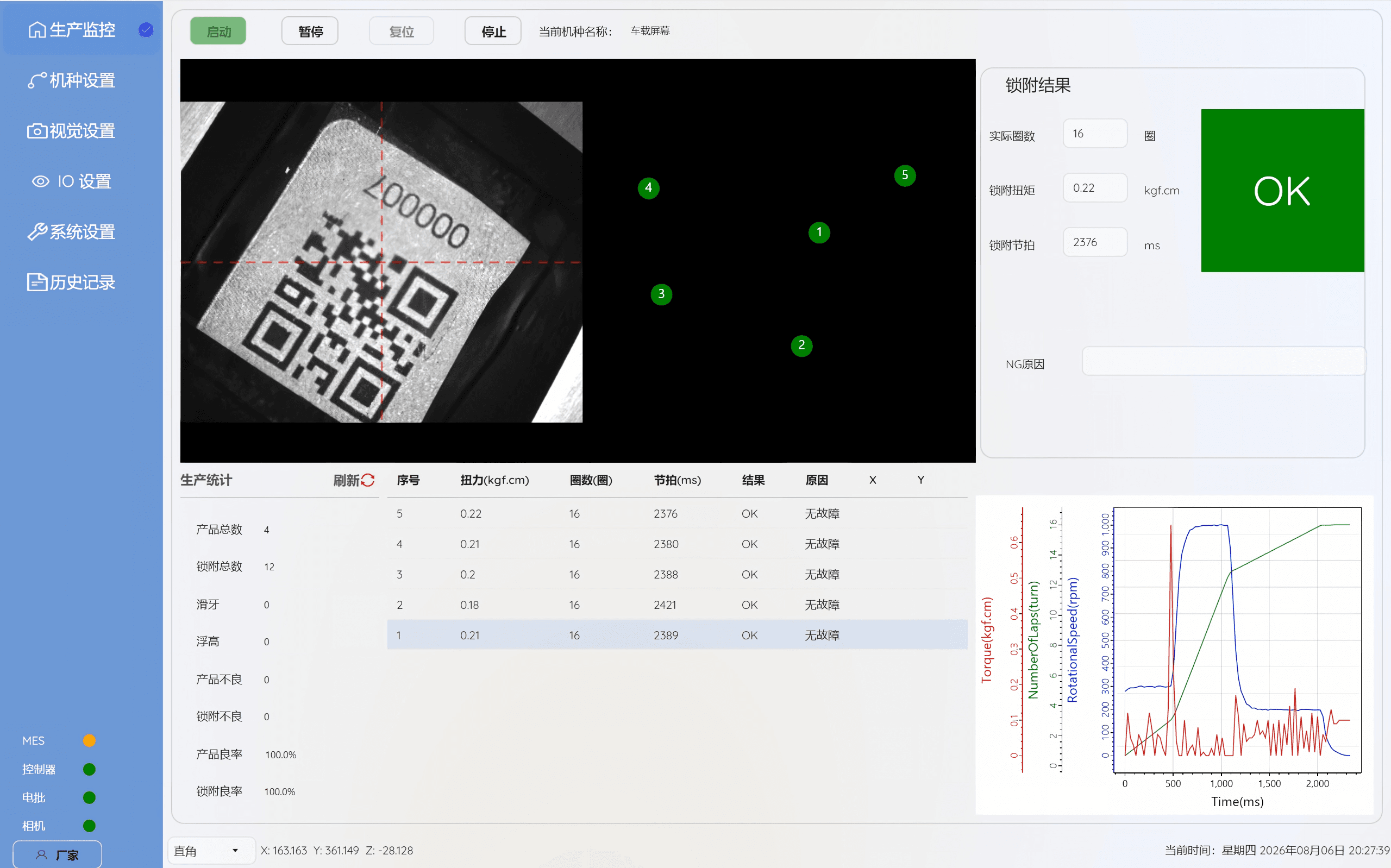
Loading & positioning → image capture to identify all screw holes → optimal path planning → automatic screw feeding → servo fastening → OK/NG judgment → data upload to MES → unloading
Advantages of the iNexBot Solution
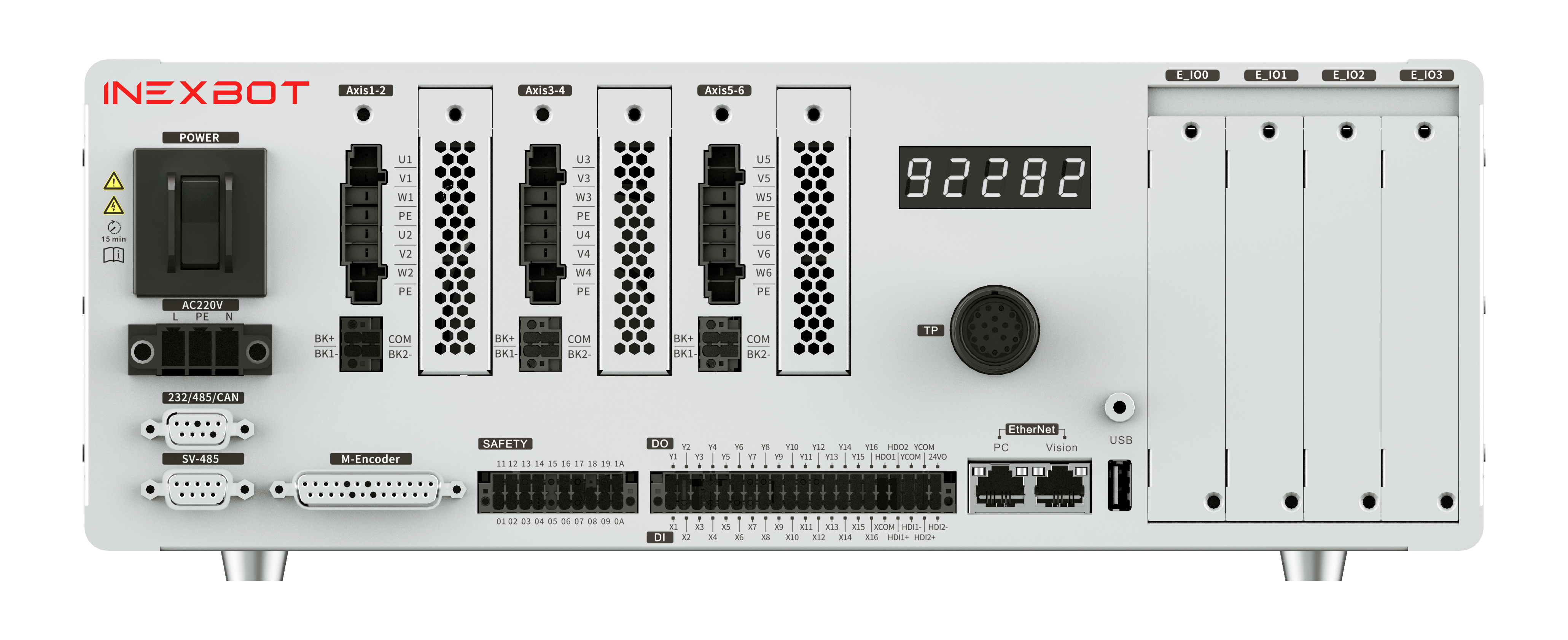
- Motion control + host PC in one: while driving robot motion, the controller can directly run host-PC programs, eliminating a separate industrial PC for a more compact, cost-effective design
- Embedded vision algorithms: no separate vision IPC needed; alignment accuracy of ±0.02 mm
- Plug-and-display: the controller supports direct monitor connection — display and touch operation right after power-on, with no separate workstation or HMI required
- Smart screwdriver: closed-loop control of three parameters; alarms for stripped threads, screw float, skewed fastening and other anomalies; fastening accuracy of ±0.5° with real-time curve evaluation
- Fast product changeover: one-click product template switching, line changeover in minutes
- Full traceability: data for every screw bound to its SN and uploaded to MES for complete traceability
- High throughput: 0.8–1.5 s per point, 2–4× faster than manual operation
- Broad compatibility: supports M1.2–M4 screws; simply swap the driver bit to adapt
- Open interfaces: TCP/MES/Modbus data interfaces for seamless integration with production-line systems