Six-Axis Robot Application Case
Application: a 15kg six-axis articulated robot with a C-frame open-back press, processing sheared blanks through 12 operations to finished parts.
Deployed Solution
- Communication: hardwired I/O, with robots exchanging "pick/place allowed" and "pick/place complete" signals.
- End effector: dual-gripper suction tooling — the primary gripper handles parts while the secondary gripper removes scrap in parallel.
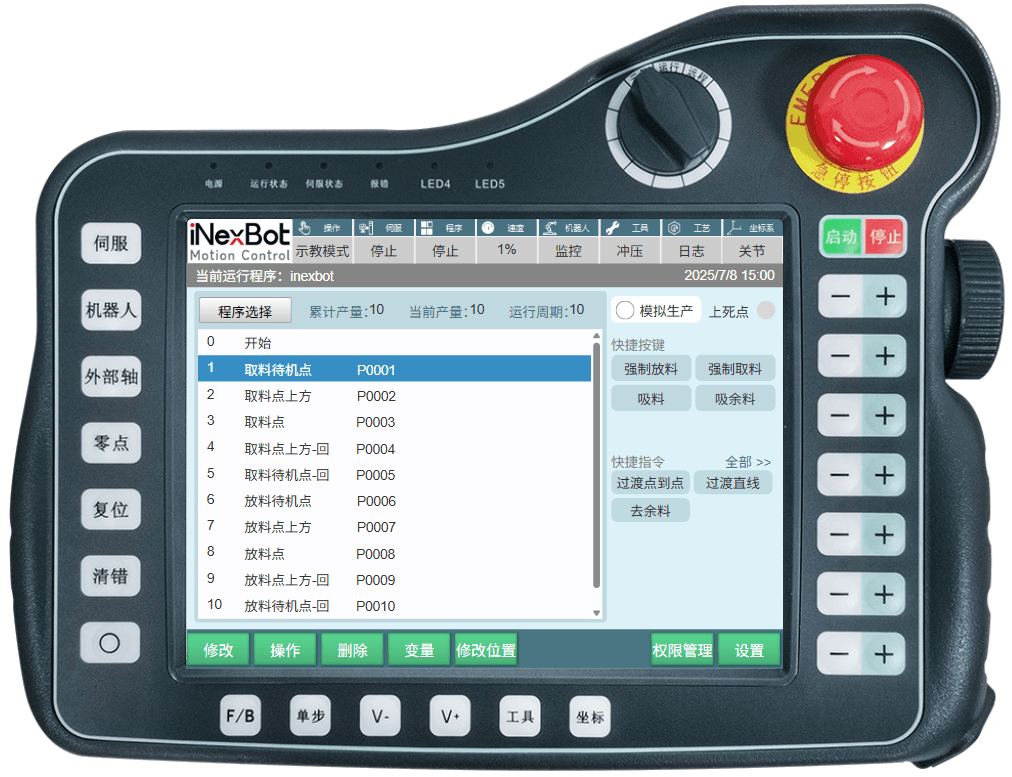
- Programming template: translation-type four-point calibration for high-precision pick and place.
- Press control: wired to mode selection, press start, and top-dead-center signals, with built-in safety light curtains.
- Data monitoring: connects to a production dashboard via Modbus for real-time cycle time and fault display.
Traditional Pain Points Solved
| Traditional Problem | Our Advantage |
|---|---|
| Manual placement misalignment damages dies | Four-point calibration ensures ±0.2mm pick/place accuracy and extends die life |
| 12-operation line is complex and hard to troubleshoot | IO handshake signals with a robust error-proofing mechanism — a single station fault does not stop the line |
| Scrap buildup requires line stops for cleanup | Dual-gripper design removes scrap in parallel with no extra downtime |
| Opaque production data and lagging management | Modbus dashboard provides real-time monitoring for digital management |
Core Value
- Cycle time: a stable 10 PCS/min
- Labor replacement: one line replaces 3-4 skilled workers
- Result: fully automated "lights-out production" for laptop back-cover forming
Four-Axis Swing-Arm Robot Application Case
Application: a mixed line of four-axis and five-axis swing-arm robots with open-back presses, forming parts through 6 operations.
Deployed Solution
- Communication: hardwired I/O with electrical signaling plus built-in interference zones to prevent collisions between machines.
- End effector: single-gripper suction tooling.
- Programming template: supports translation and flip templates with automatic program generation for fast changeovers.
- Closed-loop press control: wired to 5 signals — mode selection, press start, top dead center, and emergency stop input/output — for linked e-stop response.
- Quality inspection: manual spot checks retained as final confirmation.
Traditional Pain Points Solved
| Traditional Problem | Our Advantage |
|---|---|
| Multiple robots working in one area risk collisions | Built-in interference zones provide intelligent avoidance for safety |
| Slow die and line changeovers hurt flexibility | Translation/flip templates auto-generate programs, cutting changeover time by 50% |
| Slow press fault response can cause jamming | 5-signal closed-loop control stops everything instantly on anomalies, eliminating stacked or double-fed blanks |
| Offline spot checks lag and consistency suffers | Robots achieve ±0.05mm repeat positioning accuracy; spot checks are merely supplementary, greatly improving yield |
Core Value
- Cycle time: up to 15 PCS/min
- Safety: closed-loop control with e-stop signals keeps equipment and personnel safe even at high speed
- Flexibility: ideal for rapid switching between multiple varieties in small batches
From "human-machine collaboration" to "machine-to-machine interconnection", we combine hardwired I/O with Modbus software communication to completely solve the chronic problems of traditional stamping workshops: high noise, high danger, and low efficiency.
Whether it is a complex laptop shell or a high-speed small stamping part, our robotic stamping solutions deliver:
- Zero injuries (safety light curtains + interference zones + closed-loop e-stop)
- High precision (repeat positioning ≤±0.05mm)
- Stable around-the-clock output (24/7 uninterrupted)