Stamping is widely used today because of its high production efficiency and low material consumption. In the robotics industry, the competitive edge comes down to stamping cycle speed.
Today, let's discuss some ideas on how to increase stamping cycle speed.
Why Cycle Speed Stays Low
Generally speaking, a stamping program consists of the pick standby point, place standby point, pick approach point, place approach point, pick point, and place point.
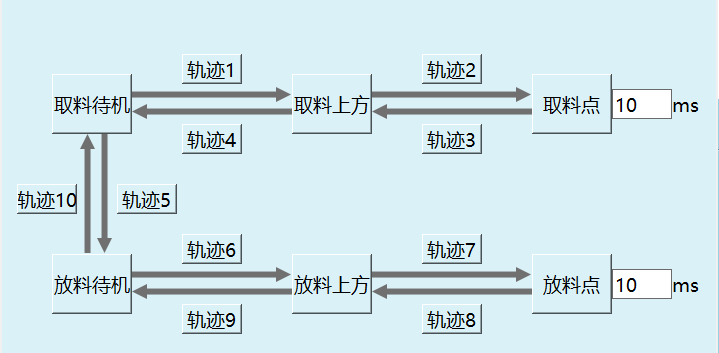
The approach points and the place point are all inside the press, so signals are generally processed at the pick standby point and the place standby point. Each time the press moves from top dead center to bottom dead center and back to top dead center, we consider one normal stamping stroke to have been completed. At this point the robot performs its picking or placing action and returns to the standby point for that stage, then tells the rear robot to pick or the front robot to place.
This logic works correctly, but it wastes a lot of time. Because all decisions are made at the standby points, the front or rear robot can only perform its picking or placing operation after the current robot has returned to its standby point. As a result, the line exhibits pauses at certain positions over time.
How to Increase Cycle Speed
First, we must ensure that the robots do not collide with the press while picking or placing. Second, the front and rear robots must not interfere with each other during picking and placing.
Under these two preconditions, let T1 be the time the press takes for one normal stamping stroke, T2 the time the rear robot takes to travel from the pick standby point to the pick point and back, and T3 the time the front robot takes to travel from the place standby point to the place point and back.
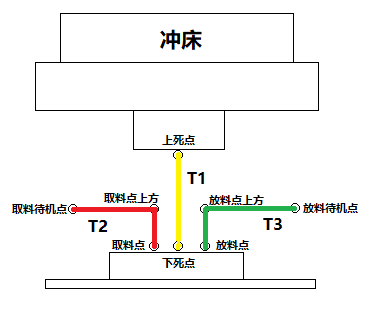
Previously, waiting at the standby points and deciding whether to pick or place based on signals required a total time of T1+T2+T3. However, the rear robot can start its picking action while the press is returning from bottom dead center to top dead center. Following this line of reasoning, as long as the time taken by the rear robot's picking action plus the time taken by the front robot's placing action is less than the time for the press to travel from bottom dead center to top dead center and back (one normal stamping cycle) — that is, T2+T3 < T1 (equality would cause a collision, and margin for error must be reserved) — the overall stamping cycle can be greatly shortened and cycle speed increased. The time drops from T1+T2+T3 to roughly 1.5 times T1.
Summary
This shifts the robot's operating logic from position-based decisions to time-based decisions about how long each action takes. With the precondition that the robots never interfere with each other, increasing the number of motions completed per unit time optimizes the stamping cycle.