It was noon, and the sun made me drowsy. As usual, I walked into the workshop, powered on the robot control cabinet, and picked up the teach pendant, ready to adjust points just like yesterday — preparing the robot for its fate of repetitive work ahead.
"I'm so sleepy." I pulled out a cigarette and was about to light it when the no-smoking sign on the wall reminded me. "Smoking in the workshop gets you fired," I thought, so I could only sniff the unlit cigarette and put it back into the crumpled, misshapen pack.
It was tiring work, and the points were complex. I was losing patience, and sweat from my forehead blurred my eyes. Frustrated, I jabbed randomly at a few ugly buttons on the teach pendant.
Suddenly a popup appeared: "Zero point calibration successful".
Reading the words on the screen, my heart sank. Losing the zero point was a disaster — not only were the painstakingly tuned points gone, but the robot's accuracy was gone too.
"What do I do?!" I grew even more anxious. The accuracy of this robot had been calibrated by specialists hired at great expense by the factory director. And now... I could already see my miserable future.
My colleague walked over and reassured me: "Don't worry, a lost zero point can be recovered. The iNexBot system our factory uses can find a lost zero point easily!"
So the question is: what is a zero point? And how do you recover it? My colleague explained it to me in detail.
01 What Is a Zero Point
The robot zero point is the initial position of the robot's operating model. Every robot has its zero point set at the factory. When the zero point is incorrect, the robot cannot move correctly, and the zero point must be recalibrated.
02 Why the Zero Point Matters
An industrial robot performs best only when its zero point is fully and correctly calibrated. During operation, the controller drives each motion axis — only by knowing the position of each axis can the robot achieve its highest point and trajectory accuracy, or move exactly as programmed.
Reading the serial pulse encoder signals at known mechanical reference points is the zero point reset process. This zero point reset data is saved in the controller backup together with other user data, and is maintained by battery power when the controller is disconnected from the main supply. When the controller is powered off under normal conditions, the current data of each serial pulse encoder is retained in the encoder. When the controller is powered on again, it reads the data from the encoders.
If the calibration fails at power-on, the only thing the robot can do is manual operation in joint mode. In that case, the robot must be re-zeroed and recalibrated.
03 Three Methods for Calibrating the Zero Point
A complete zero point calibration includes calibrating the zero point for each axis. Note that after completing any calibration method, the multi-turn value must be cleared to zero.
1) Visual Alignment Method
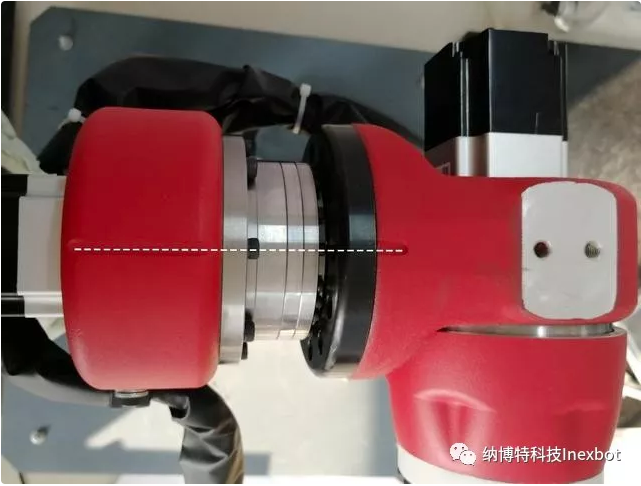
Calibrate according to the robot's alignment holes, judged by the naked eye.
2) Laser Calibration
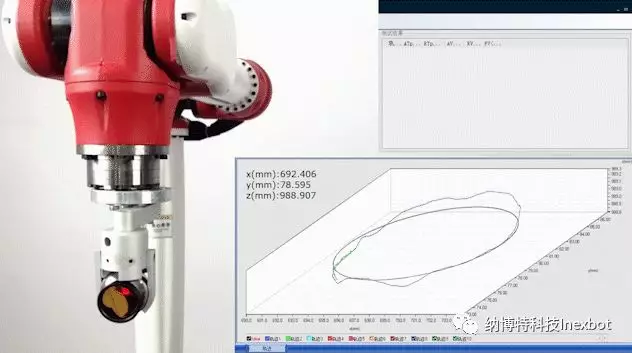
Calibrated with a laser calibration device. However, laser calibration devices are expensive and not suitable for everyday use.
3) iNexBot 20-Point Calibration
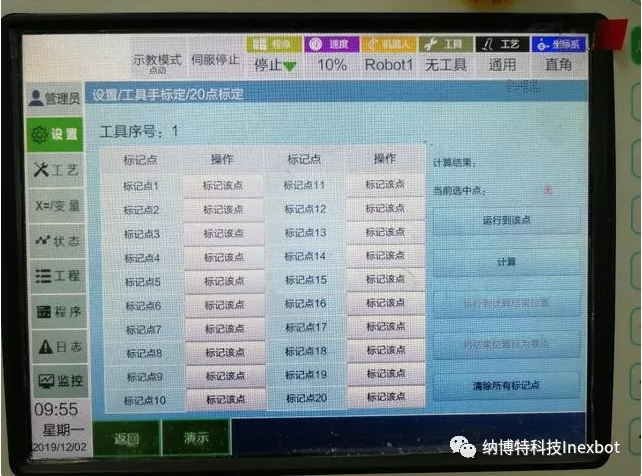
This is an algorithm built into the iNexBot system. After simply calibrating 20 points tip-to-tip, it automatically compensates for the zero point position and can also calculate the dimensions of the tool in use.
04
Encoder principles involved An encoder is a rotary sensor that converts rotational displacement into a series of digital pulse signals. These pulses can be used to control angular displacement; if the encoder is combined with a rack and pinion or a lead screw, it can also be used to measure linear displacement.
1) What Is the Multi-Turn Value
The multi-turn value is the number of revolutions of the servo motor.
2) What Is the Single-Turn Value
The single-turn value is the number of pulses per revolution, derived from the resolution and the rotation angle.
05 Recovering the Zero Point
-
Notice positional deviation and confirm the zero point has been lost;
-
Manually move the robot to a position close to the original zero point;
-
Clear the multi-turn value to zero and fill in the originally recorded single-turn value;
-
The zero point is recovered.
06 Normally the Zero Point Is Set at the Factory — When Do You Need to Recover It?
-
The battery of the encoder inside the robot body is dead or the power supply line was disconnected, and the drive alarms due to a lost encoder revolution count;
-
The robot exceeded its mechanical limits, e.g. the robot collapsed;
-
A collision with a workpiece or the environment caused the pulse count to no longer indicate the axis angle;
-
The single-turn and multi-turn values stored in the controller were deleted;
-
An erroneous operation triggered a re-calibration to zero;
-
Other situations that may cause zero point loss.